
Your Franchise Picked Your Digital Mailbox Vendor. It Did Not Pick Your CRD.
The App Has a Corporate Logo. The Deficiency Notice Has Your Name.
If you own a PostNet, a PostalAnnex, or a UPS Store, somebody at headquarters already decided how your mailbox customers see their mail online. PostNet announced iPostal1 and Anytime Mailbox as its virtual mailbox partners back in 2017. PostalAnnex locations list iPostal1, Anytime Mailbox, and PostScan Mail as their digital mailbox partners. The UPS Store Digital Mail app appeared on the App Store in July 2026. For the customer, that is a good deal: a national brand, a working app, a familiar sign-up.
For the owner, it creates a quiet assumption that the compliance side moved along with the app. It did not. The network sells the mailbox. USPS regulates the agency. And the agency, under the Domestic Mail Manual, is the store.
This article is about the gap between those two facts: who is actually responsible for Form 1583 and the Customer Registration Database at a franchise mailbox store, which customers the network's tooling never touches, and what you can fix without changing a single thing about the app.
The CMRA of Record Is the Store, Not the Brand
DMM 508.1.8 sets the rules for a Commercial Mail Receiving Agency (CMRA). Before a store can receive mail for customers, the person who establishes, owns, or manages the CMRA files PS Form 1583-A with the postmaster responsible for the delivery address. That form is where the obligations attach, and it carries three things a franchisor and a network never put their names on: your business, your delivery address, and your signature.
Everything downstream follows from that registration:
- Form 1583 for every addressee. Each customer, and each person authorized to receive mail at a box, completes PS Form 1583 with two forms of current ID. The CMRA keeps the executed form.
- The CRD entry. Since October 25, 2023, under rules effective July 9, 2023, the CMRA enters each customer's Form 1583 data and uploads legible images of both IDs to the USPS Customer Registration Database through the Business Customer Gateway. Access to the CRD is tied to your CMRA registration, not to any network's account.
- Quarterly certification. Four times a year, on January 15, April 15, July 15, and October 15, the CMRA certifies that every Form 1583 on file is current, every termination date is recorded, and no ID on file has expired.
- Terminations. When a customer leaves, the termination date goes into the CRD, the Form 1583 is retained for at least six months, and the former customer's mail is remailed with new postage for six months.
A deficiency notice from USPS goes to the CMRA named on the 1583-A. A deficiency left uncured for 30 days can end the CMRA authorization. The franchise agreement does not change the addressee on that letter, and neither does the network agreement.
Three Rosters, One CRID
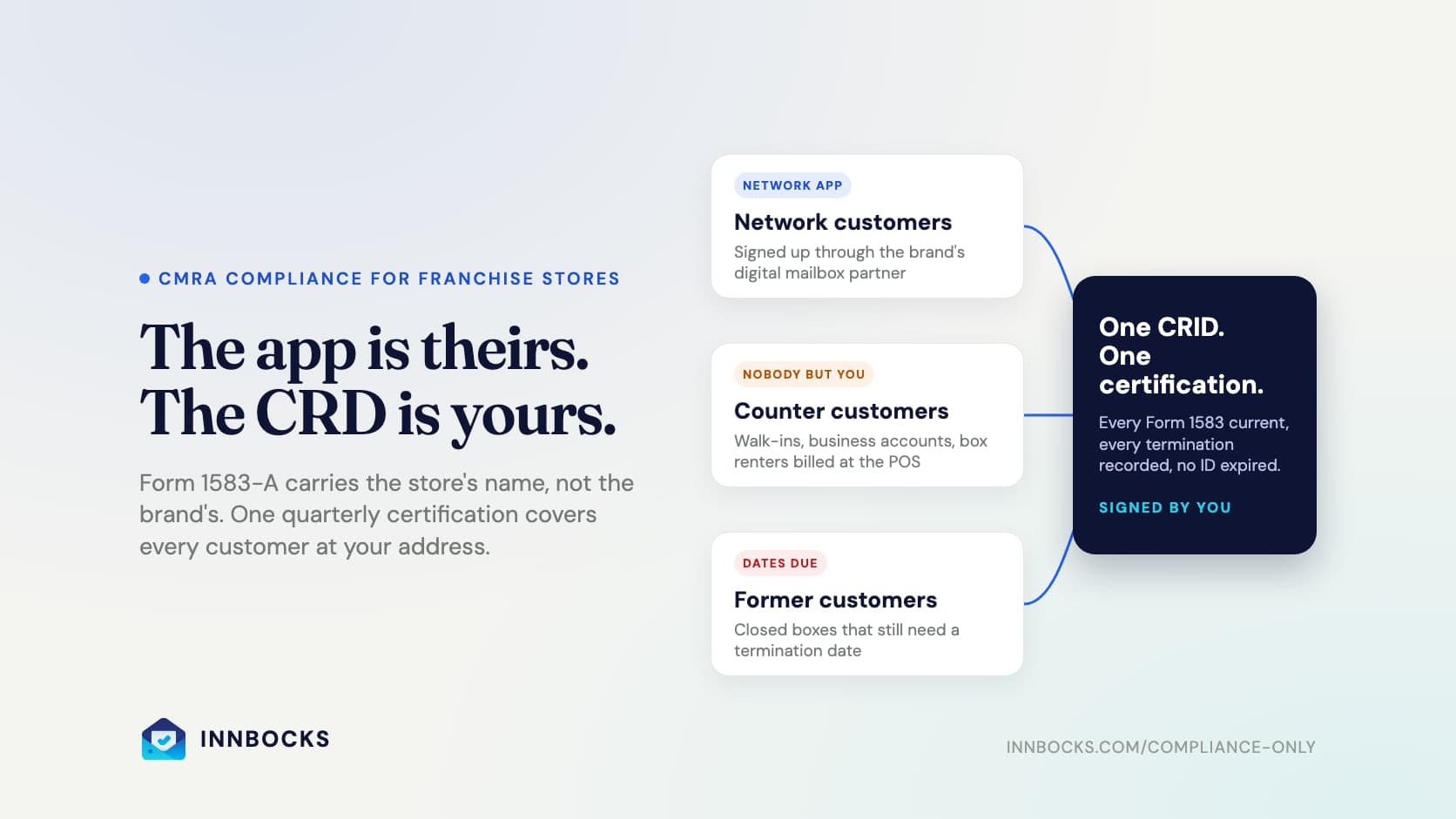
Here is the part that catches franchise owners. A store with a network partner does not have one customer list. It has three, and the network's tooling covers at most one of them.
| Roster | Who collects the Form 1583 | Who holds the ID images | Who enters the CRD record | Who records the termination |
|---|---|---|---|---|
| Network customers (signed up through iPostal1, Anytime Mailbox, PostScan, or the brand's app) | Usually the network, at sign-up | Usually the network's portal; sometimes forwarded to you | Varies by agreement. Some networks offer it for a per-upload charge; many leave it to you | You, when the network tells you the account closed |
| Counter customers (walk-ins, long-time box renters, business accounts billed through your POS) | You | You | You | You |
| Former customers (boxes closed in the last two years) | Already on file, if it was ever collected | On file, if a legible copy was ever kept | The termination date, entered by you | You |
The quarterly certification does not distinguish between them. When you sign on January 15, you are attesting to all three rosters under one Customer Registration ID (CRID).
The counter roster is where most of the risk sits. These are the customers the brand never sees: the accountant who has rented box 112 since 2019, the contractor whose LLC gets packages there, the family that pays at the counter every six months. No portal collected a form from them. No one uploaded their IDs. If the forms exist, they are in a drawer, and some of the IDs on them have expired.
What "The Network Handles Compliance" Usually Means
Ask a network what it does about Form 1583 and the answer is usually true and incomplete. At sign-up, the customer completes a 1583 inside the network's flow, and the network collects the two IDs because it cannot activate the mailbox without them. That is real work and it is worth having.
It is also where the handling tends to stop. Read your network agreement, or ask in writing, for the answers to five questions:
- Who holds the executed Form 1583? The DMM requires the CMRA to keep it. If the only copy lives in a network portal you could lose access to, you do not hold it.
- Do both ID images reach you? You need them for the CRD upload, and you need the expiration dates.
- Who enters the record in the CRD, under whose CRID? At least one network now offers to upload records for the customers it sends you, for a per-upload charge. If yours does not, the entry is yours to make.
- Who records terminations? When a customer cancels through the app, does anyone tell you the date, and does anyone enter it in the CRD?
- Who signs the quarterly certification? This one has only one answer. You do, for every customer at the address.
None of this is a reason to drop the network. The network brings customers. It is a reason to stop assuming that a customer who signed up through an app is a customer whose record is in the CRD.
The Certification Covers Everyone, and USPS Is Looking
The USPS Office of Inspector General published its audit of the CMRA program on June 24, 2025. As of February 2025 there were nearly 12,000 CMRAs serving more than 1.6 million registered customers, and the auditors reported compliance problems across the program: missing or outdated applications, inaccurate data, and incomplete mail samples. The report's recommendations push the Postal Service toward tighter oversight of exactly the records the quarterly certification covers.
For a franchise store, the practical reading is this. Your brand's app being current does not make your CRD current. The certification you sign four times a year asserts that every Form 1583 on file is current, every termination is recorded, and no ID has expired, across all three rosters. If the counter roster is not in the database, the certification is not true, and it was signed by you.
What You Can Fix Without Touching the App
The good news for a franchise owner is that nothing here requires changing the mail software. The app, the POS, the pricing, and the brand stay exactly as corporate set them. What needs to exist beside them is a system of record for the compliance side.
That is what a compliance-only account on Innbocks is for. It runs the USPS side and nothing else:
- Import the roster with PMB numbers. One record per addressee, including the business accounts that list several people, so you can see at a glance who has a current form and who does not.
- Collect Form 1583 and two IDs from the counter roster. Each customer gets a link to a pre-filled form on their phone, uploads two IDs, and signs in your physical presence, by live video with your staff, or in front of an integrated online notary. Nothing is printed or re-keyed.
- Track ID expirations and changes. Expiration dates are read from the document and reminders go out before a license lapses, which is the quiet failure that breaks a certification.
- Prepare every CRD entry. The Prepare for CRD ledger gathers the approved form, both ID images, and the fields the Gateway asks for, and flags what is missing. You enter each record yourself with the browser extension guiding every field, or you hand the filings to the Managed CRD Service and the Innbocks team enters them under your CRID with evidence recorded for every upload.
- Certify from a clean list. Before each deadline, the roster is assembled, open tasks and expired IDs are listed, and you sign an attestation you can stand behind.
Your network customers can be imported alongside the counter roster so the certification covers everyone. Your customers see Innbocks only when they complete their compliance steps. The app they use for mail does not change.
Responsibility for CMRA compliance stays with the operator, the same as it always has. The difference is that the operator can finally see it.
See how a compliance-only account works, or score your store's readiness in two minutes.
Sources
- Domestic Mail Manual 508.1.8, Commercial Mail Receiving Agencies (USPS)
- Commercial Mail Receiving Agency (CMRA) knowledge article (USPS)
- Postal Bulletin 22624, DMM Revision: Commercial Mail Receiving Agencies (USPS)
- Management of Commercial Mail Receiving Agencies, Report 24-146-R25 (USPS Office of Inspector General, June 24, 2025)
- PostNet Becomes First National Franchise to Offer Virtual Mailbox Solutions (Franchising.com, July 2017)
- PostalAnnex Bedford, TX: digital mailbox partners (PostalAnnex)
- The UPS Store Digital Mail (App Store)
- iPostal1 Compliance Center (iPostal1 Workspace)
Related reading
- The 90-Day Plan to Get Your Store's CRD Current Before January 15
- What Is CRD?
- How to Get USPS CRD Access
- Quarterly certification: dates, what the attestation covers, and how to prepare
- Customer termination: what USPS requires when a customer leaves
- USPS Compliance Center, our operator reference covering Form 1583 execution, ID requirements, CRD duties, quarterly certification, PMB addressing, and termination rules
Written for franchise mailbox store owners searching for: "PostNet Form 1583 compliance," "PostalAnnex CRD requirements," "UPS Store CMRA quarterly certification," "who is responsible for CRD at a franchise store," and "does iPostal1 handle Form 1583."
Innbocks provides software that supports USPS CMRA compliance workflows, including Form 1583 collection, e-notarization, and CRD task tracking. Innbocks is not affiliated with the U.S. Postal Service and does not provide legal advice. The operator of each CMRA remains responsible for satisfying USPS requirements, including those in Domestic Mail Manual 508.1.8. Always verify current rules against official USPS sources.
This article is part of our USPS Compliance Center.